
Table of Contents
Have you also noticed a drop in clicks from Google? Did you experience fewer clicks on your website?
Currently, there are so many individuals who are raising queries on websites like ChatGPT, Gemini, Perplexity, and Google Search, getting replies immediately from the same platform without having to visit any website. This is the point where Generative Engine Optimization (GEO) becomes important.
In this blog post, we'll go into GEO in more detail, covering GEO services, how it works, why it matters for your business, and where it differs from traditional SEO.
What is Generative Engine Optimization?
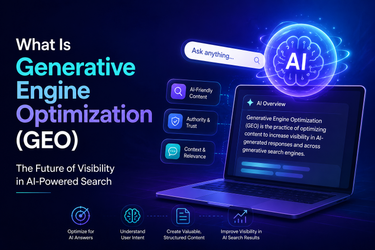
GEO is the content optimization for the new era of AI-driven search and chat applications. It ensures that your brand or product is mentioned, cited, or recommended by generative engines such as ChatGPT, Google AI Overviews, Gemini, Perplexity, Claude, and Microsoft Copilot.
With the support of regular search engines, you get blue links, but with generative engines, you get a conversation answer that relies on many sources. In short, SEO gets you to the results page, but GEO gets you to the answer.
Why GEO Matters Now
The use of AI search tools has been growing increasingly quickly in recent years. More people now type their entire search query into chat tools rather than typing individual keywords using Google search. The considerations for businesses in this regard include:
- Less traffic to your website or website ranking, despite the fact that your business is often mentioned on the web
- More chances of gaining credibility through AI citations
- Revised notion of "visibility" and "ranking"
Businesses which do not undertake this transition risk disappearing in an increasingly larger number of searches, even if they enjoy high rankings on other types of search engines.
How GEO Works
GEO customizes your content based on the way LLMs gather, understand, and reference information. While crawlers mainly depend on keywords and backlinks, the generative engines analyze the content based on its structural clarity, accuracy, and subjectivity.
The whole process works in a more straightforward way:
1. Data Gathering and Training
AI models typically lean on enormous collections of websites, discussion boards, academic articles, and other materials that are publicly accessible. The supporting tools, like Perplexity and Google AI Overviews, don't just sit on stored training either; they also pull from live web lookups, so the responses are more current instead of depending only on the pre-trained stuff.
2. Content Evaluation
Whenever the generative engine generates a response to the request, it evaluates the sources by several parameters:
- Relevance of the source to the question of the user
- The structure and clarity of the information
- The reliability of the source (author's expertise, website's reliability, citations)
- The currency of the information
3. Synthesis and Response Generation
Unlike the case where the AI provides citations and references to multiple pages, this process involves combining information from several good-quality pages into one response. With such a technique, your content will have a higher possibility of being included in the answer as long as it provides an appropriate answer to a popular query.
Example: When someone asks ChatGPT, "how to structure a blog post for AI search", a structured article with clear answers and data will be favored over an unstructured piece of content that has been optimized for keywords.
Benefits of Generative Engine Optimization
- Higher Exposure on AI Platforms
- Establishes Credibility and Reliability
- Makes Your Content Strategy Future-Proof
- Drives Brand Awareness Indirectly
- Complements Current SEO Efforts
Difference between GEO & SEO
The Main Distinction:
- SEO is Search Engine Optimization and concerns improving the ranking of your page in conventional SERPs to drive clicks.
- GEO, or Generative Engine Optimization, involves getting your content cited or quoted in responses generated by the AI algorithm.
Differences Between SEO and GEO
By comparing the two strategies, the difference between them immediately becomes visible...
Click-through rate and page rank are the main indicators of a successful SEO strategy, while the number of citations and visibility in AI-powered solutions are what count when one speaks about GEO.
Both of Them Required?
Yes. SEO and GEO complement each other. Technical SEO (good speed, good structure, good backlinks) is still important...
How to Optimize for AI Search
- Create an Answer-Focused and Question-Based Text
- Structure
- Add Facts, Figures, Statistics, and Unique Insights
- Optimize for Snippets and Answers
- Develop Topical Authority
- Follow E-E-A-T
- Track AI Mentions/Citations
Bottom Line
With Generative Engine Optimization now a must for those organizations who wish to remain relevant...
GEO Services depends on classic SEO principles but introduces new ways of optimizing content with clarity, structure, and the answer-first approach.
What are you waiting for to make your business future-ready? Book a free AI SEO consultation with AdsRole today.
FAQs
No. Even the two processes complement each other, as they address both conventional search engines, such as Google and Bing, and AI-based search engines.
Unlike AEO, which addresses content featured in AI-based answer boxes, GEO focuses on optimizing content for AI-based generative tools.
Yes. AI tools can cite small businesses based on niche expertise, structured content, and answerable questions, enabling them to benefit from GEO even without significant brand recognition.
Yes. Technical SEO elements such as page speed, responsiveness, and structured content remain important, since generative engines use the same web data as traditional search engines do.
Although it is an emerging area, there are some new tools to track mentions and citations of your brand in AI-generated answers. Direct traffic and brand search volume can also be used as indirect measures of GEO efforts.
Absolutely! Local businesses can use GEO Services by ensuring their content provides accurate answers to relevant questions, thereby providing structured information for AI.
GEO works best for industries in which users conduct research before their decision-making, including health care, finance, technology, and professional services, as users tend to ask detailed questions of AI before making purchases.
To get expert advice on this issue, you should consider AI SEO services.